

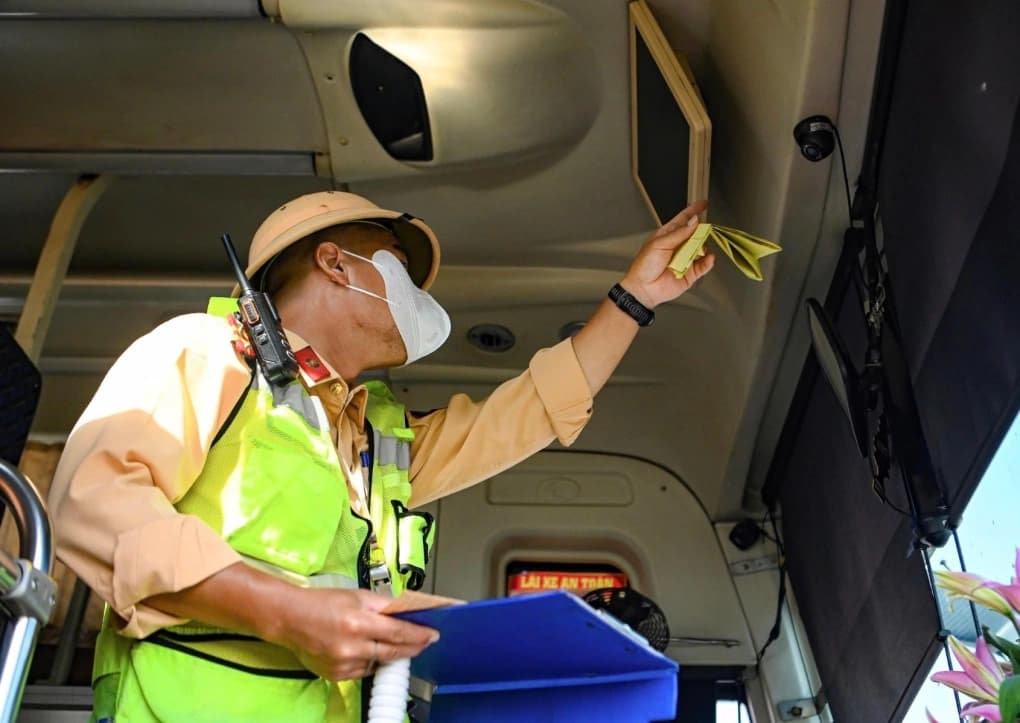
"The Ministry of Public Security has proposed that real-time camera footage of drivers and passenger cabins on certain transport vehicles be transmitted directly to the Traffic Police Department's system." The Ministry of Public Security (MPS) is currently seeking public feedback on the second draft of a Decree regulating journey monitoring devices, driver-facing cameras, passenger cabin-facing cameras on road vehicles, and the data management systems for these devices.
According to the draft, commercial transport vehicles, tractor-trucks, ambulances, road rescue vehicles, and internal transport vehicles must be equipped with journey monitoring devices. Depending on the vehicle type and the implementation roadmap, vehicles must also be fitted with cameras recording the driver, the passenger cabin, or both. These devices can be integrated into a single system but must fully meet the technical requirements for each individual function.
The monitoring devices must record the vehicle’s route, speed, parking stops, and continuous driving time. On-board cameras must continuously capture images of the driver and the passenger cabin, including passengers boarding and alighting from the vehicle under all lighting conditions.
The MPS proposes that all data from journey monitoring devices, driver-facing cameras, and passenger cabin cameras be transmitted to the service provider's servers, and then forwarded to the Traffic Police Department's system in real time.
According to the drafting agency, this data will serve as a legal basis for handling violations of road traffic order and safety, while also supporting security and social order management.
Journey data must be stored for a minimum of 30 days on the device, one year on the service provider's server, and three years on the Traffic Police Department's system. Driver images must be stored for at least three days, while passenger cabin images must be kept for a minimum of 10 days.
The draft proposes that starting January 1, 2028, commercial passenger vehicles with fewer than 8 seats (excluding the driver's seat), commercial goods transport vehicles (except tractor-trucks), and internal transport vehicles must install driver-facing cameras.
From January 1, 2029, commercial passenger vehicles with over 29 seats must be equipped with passenger cabin-facing cameras. The requirement will expand to vehicles with 8 to 29 seats starting January 1, 2030.
The MPS stated that many countries have already deployed journey monitoring systems and on-board cameras to early detect behaviors that compromise traffic safety. Meanwhile, current regulations in Vietnam do not yet require these devices to feature automatic detection, hazard warnings, or real-time data transmission.
According to the drafting agency, the addition of these new regulations will establish a solid legal framework for monitoring, supervising, and penalizing violations by commercial transport vehicles, thereby contributing to the prevention and reduction of traffic accidents.
Source: VnExpress





%20(1).png&w=3840&q=75)